Air Canada reported a dip in second-quarter profit on Monday, with net income falling to C$0.60 per share—down from C$0.98 a year earlier—despite a revenue increase to C$5.63 billion.
The carrier cited weaker passenger traffic to the United States, its largest international market, as a key contributor to the profit decline. The slowdown comes amid escalating political tensions between the two countries, including President Donald Trump’s controversial remarks about Canada and ongoing trade disputes.
The pullback was felt most acutely during the peak summer travel period, typically the most profitable for airlines.
RELATED: Air Canada Vacations Celebrates Independent Advisors
"We remained disciplined and consistent in executing on a long-term plan that is rooted in Air Canada’s proven commercial strategy, while navigating macroeconomic uncertainty and geopolitical tensions," said Michael Rousseau, President and Chief Executive Officer of Air Canada.
"We have strategically redirected capacity to high-demand markets and captured demand for premium services, leveraging the breadth and strength of our global network.”
Air Canada still transported 11.6 million passengers in the quarter and posted operating income of $418 million, with adjusted EBITDA of $909 million. Rousseau noted continued demand for premium services and strong contributions from Aeroplan, Vacations, and Cargo, calling them “key pillars of our diversified business.”
Looking ahead, the carrier plans to increase third-quarter capacity by 3.25% to 3.75% and reaffirmed its full-year guidance, with adjusted EBITDA projected between $3.2 billion and $3.6 billion.
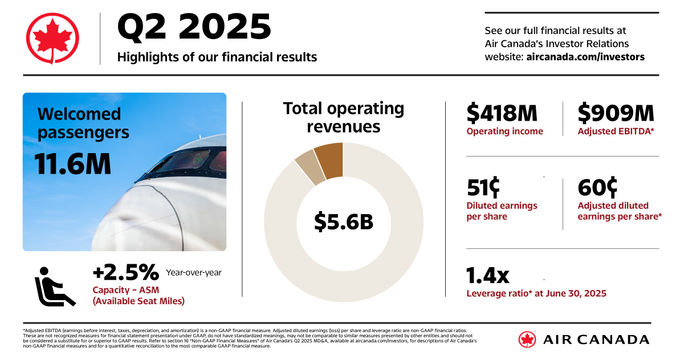
Air Canada reports Q2 2025 financial results (Photo Credit: Air Canada)
Labour Unrest Looms
The earnings release comes as more than 10,000 flight attendants at Air Canada and Air Canada Rouge begin casting strike votes. Represented by the Air Canada Component of the Canadian Union of Public Employees (CUPE), workers are voting from July 29 to August 5. If the vote passes, the union will be in a legal strike position as early as August 16.
The flight attendants have been without a contract since March 31. The previous agreement, in place since 2015, included two percent annual wage increases.
RELATED: Air Canada Flight Attendants Begin Strike Vote July 28 Amid Stalled Contract Talks
“The conciliation process has concluded without a tentative agreement,” union leaders told members Friday. “We are now preparing to move forward with a strong strike mandate and are seeking your support.”
Air Canada downplayed the vote in its own Friday statement, calling it “a normal step in the negotiation process.” The airline said it remains “fully available to continue negotiations towards a fair and equitable collective agreement with CUPE.”
Topics From This Article to Explore


