Facing a drop in U.S.-bound bookings and rising operational costs, Air Canada posted a first-quarter operating loss of $108 million in 2025, despite generating $5.2 billion in revenue.
The 1% year-over-year revenue decline—coupled with a 10% drop in U.S. travel demand, weakened cash flow, and increased expenses—signals a turbulent start to the year for the airline.
Cash flow from operating activities totalled $1.526 billion, while free cash flow came in at $831 million—both down year-over-year by $66 million and $225 million, respectively.
Operating expenses rose by 2%, totaling $5.304 billion. Despite lower fuel prices, these rising costs contributed to an operating loss of $108 million, compared to an operating income of $11 million in Q1 2024.
Adjusted earnings before interest, taxes, depreciation, and amortization (EBITDA) reached $387 million, a decrease from $453 million in Q1 2024. The adjusted net loss also increased, widening to $150 million, or $0.45 per share, compared to a loss of $96 million, or $0.27 per share, in the first quarter of 2024.
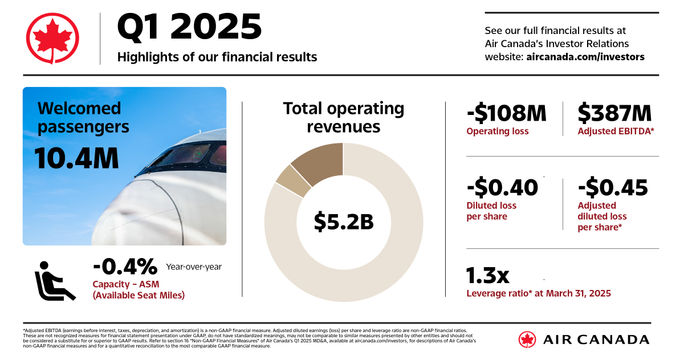
Air Canada Q1 2025 results (Photo Credit: Air Canada)
"Our first quarter 2025 results show Air Canada is effectively managing through a turbulent period," said Michael Rousseau, President and Chief Executive Officer of Air Canada.
"Total operating revenues of nearly $5.2 billion were stable year-over-year on similar capacity. Our revenue diversification strategy remains sound; sixth freedom revenues grew, and Air Canada Cargo and Air Canada Vacations delivered solid results in the period."
Air Canada completed a share buyback, repurchasing and cancelling more than 15 million shares. The airline also announced its plan to launch a substantial issuer bid to buy and cancel up to $500 million worth of shares, with the goal of enhancing shareholder value.
The airline plans to increase its available seat miles (ASM) capacity by 2% to 2.5% in the second quarter of 2025 compared to the same period in 2024. However, the airline has revised its full-year adjusted EBITDA forecast, now estimating it will be between $3.2 billion and $3.6 billion.
This adjustment is down from the previous estimate of $3.4 billion to $3.8 billion. The revision reflects expected continued softness in U.S. travel demand and ongoing cost pressures.
Despite these challenges, Air Canada says it remains committed to a long-term growth strategy, targeting operating revenues of approximately $30 billion by 2028.
“Our results demonstrate that we have a solid and diversified commercial foundation, a disciplined capital allocation strategy, and a skilled and dedicated team. We are encouraged that despite some shifts in certain markets, overall demand trends remain steady,” said Rousseau.
Topics From This Article to Explore


