
by Natasha Lair
Last updated: 10:05 AM ET, Tue September 22, 2026
Anyone who has ever tried to fly with a dog knows the first rule of pet travel: there is no simple rule.
Can they fly in the cabin? How big can the carrier be? Does the weight limit include the carrier? What about checked baggage? Cargo? Breed restrictions? And just when you think you’ve figured it out, another airline has an entirely different policy.
It’s a frustration Philippe Benoist knows well.
TravelPulse Canada spoke with Benoist, founder of MyDogCanFly.com, about why flying with a dog remains so complicated, what travel advisors should be checking before they book and how a personal trip with his golden retriever, Bailey, ultimately inspired him to build a tool designed to make the process easier.
“Bailey — my golden retriever, now four years old. He was still very young when I planned a month-long holiday on a remote island in Mexico. Beautiful beaches, a long way from everything: that was the whole point. I wanted to share that freedom with him,” Benoist told TravelPulse Canada.
RELATED: Air Canada Updates Pets in Cabin Policy
The trip would take them from Paris to Cancún, with a return flight from Mexico City to Paris. But choosing an airline proved considerably more complicated than choosing the destination.
“I was comparing Air France, Aeromexico and possible connections, trying to piece together weight limits, crate requirements and restrictions," he said.
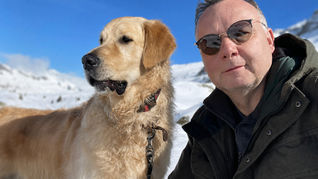 Philippe Benoist, founder of MyDogCanFly.com, with golden retriever, Bailey. (Photo Credit: Supplied)
"The information existed, but not in the same place or in the same terms. I didn't just want to know whether an airline accepted dogs in general. I wanted to know whether it could take my dog on my journey.”
Then there was another consideration: heat. Travelling with a large dog meant Benoist also had to consider conditions on the ground and whether seasonal restrictions could affect Bailey’s ability to fly.
He says he genuinely doubted whether the plan would work until they landed in Cancun together.
That experience became the starting point for MyDogCanFly.
Benoist began gathering information and building the project in April 2026, using research and AI tools to help organize the work. The challenge, he says, isn’t simply finding an answer — it’s making sure that answer is backed by an airline’s actual policy.
“For me, the useful answer is not simply yes or no. It's: under which conditions, on which route, and according to which source?”
Same Dog, Different Airline, Different Answer
In a snapshot of MyDogCanFly’s 102-airline database reviewed for this interview, 58 entries had a recorded numerical cabin weight cap. Of those, 43 were 8 kg.
But even that seemingly straightforward number can be misleading.
“The easy mistake is weighing only the dog. Where the limit includes the carrier, a 7.5 kg dog in a 1.2 kg bag is over an 8 kg allowance. Being below the dog's apparent weight limit is not enough,” said Benoist.
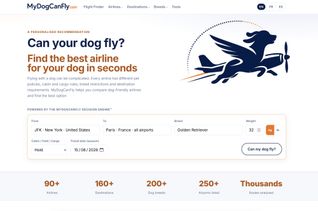 MyDogCanFly.com (Photo Credit: Supplied)
Canadian carriers provide a good example of just how differently airlines can approach the same question.
Benoist says Air Canada and WestJet describe cabin eligibility primarily through the carrier and the amount of space the animal needs inside it, while Air Transat adds an explicit 8 kg maximum for the animal and carrier combined.
RELATED: This Country Now Allows Large Dogs to Fly in Airline Cabins Next to Their Owners
Air Canada’s approach produces one of the more amusing theoretical possibilities in the database.
“Air Canada illustrates the other approach to cabin eligibility: its published requirements focus on a suitable soft carrier under the seat and enough room for the animal to stand, turn and lie down comfortably, rather than a numerical cabin weight cap," he said.
"So, in theory, the challenge with your Saint Bernard isn't the number on the scales — it's finding one who fits comfortably in that little bag. Good luck with that."
For pets travelling as checked baggage, Benoist says Air Canada, WestJet and Air Transat all publish a 45 kg maximum including the kennel, subject to route, aircraft and other restrictions.
But a shared weight limit doesn’t mean the services are interchangeable. Crate dimensions, breed restrictions, seasonal limitations and prices still need to be checked individually.
Don’t Book The Human First And Figure Out The Dog Later
One of the biggest mistakes travellers make, Benoist says, is treating their dog’s travel arrangements as something that can be dealt with once everything else is booked.
“A seat for you does not automatically mean space for your dog. The booking sequence varies by airline, so find out how to confirm the animal's place and what your cancellation options are before committing to the whole trip.”
The return trip matters just as much.
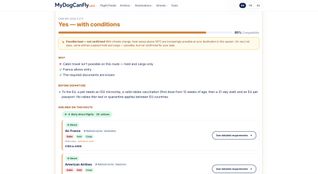 MyDogCanFly.com (Photo Credit: Supplied)
Despite Bailey having a pet passport, Benoist was required to obtain a veterinary certificate in Mexico for their return to Europe. It was valid for only 10 days, meaning a veterinary appointment had to be arranged toward the end of the holiday.
“My advice is to check the paperwork for both directions before leaving home.”
RELATED: New Partnership Helps Hotels Go to the Dogs
Weather can throw another wrench into even the best-planned itinerary.
Benoist notes that both Air Canada and WestJet publish seasonal restrictions affecting pets travelling in the hold on certain routes.
“Hot weather can therefore change whether your dog can travel at all — not just how comfortable the journey will be. In a warming climate, that's an increasingly important part of planning. Check your airline's heat restrictions for both the outward and return journeys, and remember that meeting its booking conditions doesn't guarantee that temperatures on the day will allow your dog to fly.”
What To Check
Benoist recommends starting with something that can easily be overlooked: who is actually operating each flight.
“I'd start with the operating airline on every leg — not just the name selling the ticket. Then confirm that the relevant service is available on the route, in that direction, on those dates, and that space can actually be reserved for the animal.”
From there, travellers need to consider the dog and its container: breed, age and weight; whether the published allowance includes the container; carrier dimensions; and whether the animal can comfortably fit in the required space.
Paperwork needs its own check, including departure, transit, destination and return requirements, with the timing of appointments, treatments and certificates factored into the client’s plans.
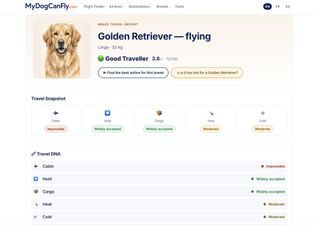 MyDogCanFly.com’s breed reports (Photo Credit: Supplied)
Connections can make things even more complicated.
“Don't assume that acceptance on the first flight carries through to the next one, even within a single booking. Check the transfer arrangements and any change of operator or aircraft.”
Brachycephalic breeds add another layer.
Benoist says owners of pugs, French bulldogs and other flat-faced breeds should pay particular attention because airlines may restrict their transportation due to increased risks of breathing problems and overheating, particularly when they are travelling away from their owner in the hold.
“Air Canada and WestJet, for example, publish restrictions on brachycephalic dogs travelling in the baggage compartment. THAI publishes its own list of breeds it will not accept as checked baggage. It's not simply a matter of finding an airline with a larger weight allowance.”
Country restrictions are another consideration, and Benoist advises checking both breed and destination requirements early — before spending time building an itinerary that may not be possible.
Even Official Information Can Conflict
Perhaps one of the most interesting things Benoist has uncovered while building the database is that even official airline sources don’t always agree.
He points to WestJet as one example.
“At the time of our review, WestJet's pet page listed a maximum checked-kennel height of 81 cm, while its published domestic tariff specified 76 cm. Two official documents, two different figures. That's a reason to seek written clarification before buying a crate, not simply choose the more generous number.”
Benoist found a similar issue while researching China Southern.
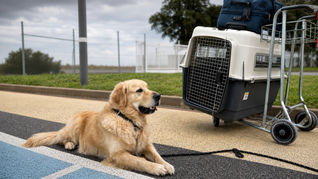 Bailey, the golden retriever whose own travels inspired MyDogCanFly.com (Photo Credit: Supplied)
The airline’s English pet page told passengers to request checked-baggage transportation for their animal at least 24 hours before a domestic flight or 48 hours before an international flight. Its Chinese baggage regulations, however, listed different deadlines: four hours domestically and six hours for international or regional flights.
Both were official documents.
For Benoist, conflicting information isn’t an invitation to choose the answer that works best.
Vocabulary can also create confusion. A dog travelling as checked baggage in the hold is not the same service as one travelling as manifest cargo, even though both may physically travel below the passenger cabin. Cargo can involve a separate booking process and, in some cases, a specialist transport agent.
“MyDogCanFly brings the key questions and official sources together, but it is not a booking system or a guarantee of acceptance," he warned.
"Before committing, travellers should confirm the arrangements for their dog and itinerary with the operating airline, ideally in writing. They should also consult their veterinarian well in advance to assess their dog’s fitness to fly and plan any required vaccinations, treatments, tests and veterinary certificates. Import permits and other administrative requirements should be checked with the relevant authorities, for both the outward and return journeys.”
Will IATA Make Flying With Pets Easier?
The tool arrives as the airline industry is also taking a closer look at pet travel.
As TravelPulse Canada recently reported, IATA has introduced new recommended standards for pets travelling in aircraft cabins, following research that found uncertainty over airline policies and whether a pet can travel remains an obstacle for travellers.
Benoist welcomes the initiative, but he doesn’t expect individual airline rules to suddenly become identical.
RELATED: Flying With Pets? IATA Introduces New In-Cabin Travel Standards
“I would distinguish, though, between more consistent procedures and identical acceptance rules. IATA’s guidance explicitly leaves individual airline policy decisions with the airlines. Travellers and advisors will therefore still need to check the requirements for their particular dog, carrier and itinerary.”
He sees IATA’s work and MyDogCanFly as complementary.
“For me, these are complementary efforts: IATA is helping improve the travel process, while MyDogCanFly aims to make the published conditions easier to find and compare before booking.”
What’s Next For MyDogCanFly?
For now, Benoist is focused on expanding the tool while keeping the information already there current.
An airline can change a condition, introduce a new service or impose an embargo, meaning maintaining the database is as important as adding to it.
He also wants to add more airlines and routes while maintaining what he describes as a clear distinction between information that has been established and information that still requires confirmation.
There are other possibilities ahead.
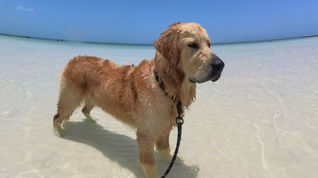 Bailey enjoys the beaches of Mexico (Photo Credit: Philippe Benoist)
After Benoist contacted the European Guide Dog Federation, the organization expressed interest in discussing the project, reinforcing his interest in creating a dedicated path for assistance-dog travel separate from ordinary pet transportation.
He is also exploring information about specialist shared-charter and private-flight options that allow owners to travel alongside their dogs.
MyDogCanFly remains free to use and, for now, a personal project.
And after digging through policies from more than 100 airlines, Benoist isn’t particularly interested in declaring one carrier the world’s most dog-friendly.
“And ‘pet-friendly’ isn't a single ranking. The useful question is whether an airline can accommodate this dog, in this container, on this journey. That's what I'm trying to make easier to answer.”
For travellers, and the advisors helping them get from A to B with a four-legged passenger in tow, that may be the most useful question of all.
Topics From This Article to Explore


