I am standing outside my hotel in Havana, feeling that I had just stepped out of a time machine. The air is thick with the sweet scent of tropical flowers and distant cigar smoke, but it’s the parade of classic cars that truly transports me back in time. A pink 1950s Ford Fairlane glides past, its chrome sparkling under the bright Caribbean sun, followed closely by a multicolored 1930s Ford Zephyr rumbling proudly down the street.
In Cuba, cars aren’t just vehicles—they're rolling relics, living history. Most automobiles you see are over 60 years old, lovingly preserved and patched together with endless ingenuity. Some are even nearing their centennial mark, yet they still cruise along Havana’s wide boulevards with a swagger reminiscent of a simpler time. These cars are long gone in most of the world except in some private collections, not open to the public. But here, they are alive, buzzing through the city like colourful characters in an endless, slow-motion dance. And the best part? You can hop into an 1952 Chevy convertible and feel like a star from another era, with the ocean breeze tangling your hair as you ride along the Malecón. “There’s a reason why Cuba is an open-air museum of vintage cars,” says our guide Ada Garcia who leads Intrepid Travel tours here. “When the US imposed trading embargo on Cuba in the 1960s, we could no longer import cars. We had to do with what we had, so people learned to fix these cars and keep them going.”
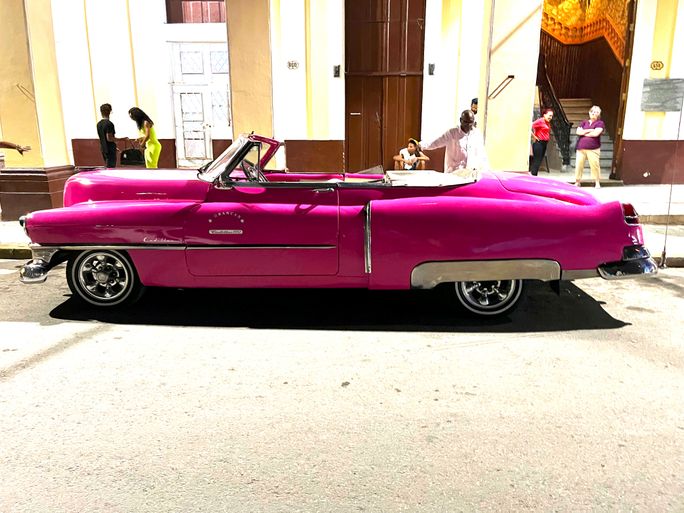
Cubans have worked hard to keep their cars in good condition despite embargos (Photo Credit: Dennis Cieri)
The US trade embargo affected nearly every aspect of Cubans’ lives, limiting trade and economic growth. It’s still felt today—by the periodic blackouts or shortage of certain supplies. The pandemic made these issues worse, too, resulting in a tourism drop.
Yet, tourists are still coming, despite these issues. Yes, there may be blackouts and there may not be coffee pods in your hotel room, but you get to see a different way of life and different social sentiments. Travelling in Cuba outside of the resort areas is not unlike going camping in the outback. You don’t expect things to be perfect. You expect inconveniences from faulting flashlights to dying fire, to being wet—but that’s part of the experience. Some 500,000 Canadians still travelled to Cuba the first quarter of 2025. Those who ventured beyond their resort had a chance to experience the bygone era that doesn’t exist anywhere else.
A must-see in Havana is the Buena Vista Social Club, an unmistakable sound of Cuba’s timeless soul. It isn’t just entertainment, it’s about laying claim to a culture, a style of music and living the very heartbeat of Havana itself. Each song is a love letter to the Cuban people, to the slower days, and even if you don’t know the lyrics, you feel the nostalgia threading through the air.
Watching the show, you understand why Cuba was once the favourite vacation spot for prewar Americans. The energizing music and lyrics pull you into the family that is the Cuban people and for a while we are all in it together. “Before communism, people of color weren’t allowed to perform in the nightclubs so they started their own private clubs,” Garcia tells us. The most successful of these clubs was the Buena Vista Social Club.
Out time-travel journey didn't stop in Havana. As you drive across the island one of the must-visit places is Viñales, the gateway to the misty Sierra de los Órganos mountains. In this tranquil town, the streets are lined with brightly painted wooden houses that seem untouched by time. Families sit on wide verandas, rocking slowly in chairs, waving at passersby. Horse-drawn carts along with cars clatter along the red-dirt roads, and the smell of rich tobacco lingers in the warm air. Here, life moves to a slower rhythm, with art galleries lining many of the streets and street artist drawing and painting in the squares. They invite you to breathe deeper, walk slower, and truly take in the moment.
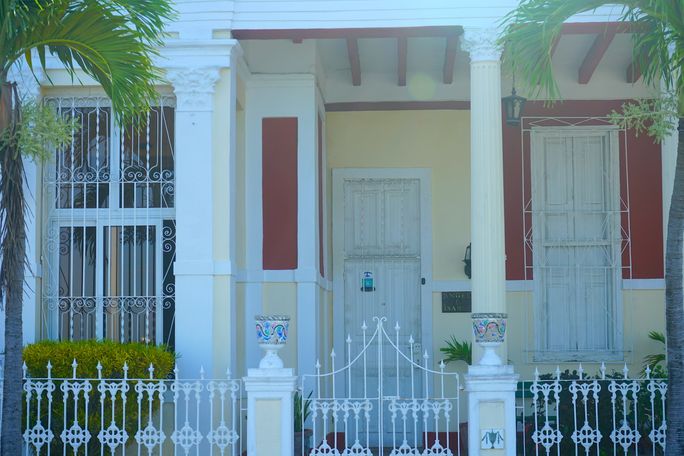
The charming facade of a guest house in Cienfuegos, Cuba (Photo Credit: Dennis Cieri)
Further along the coast, the elegant city of Cienfuegos offers a glimpse of grandeur from the past. Known as La Perla del Sur, or the Pearl of the South, it’s a city of broad boulevards, neoclassical buildings, and an old-style European flair of grace and charm. Here we stay Vista al Mar, an old mansion from a by time era. The front of the house boasts tall white columns, with a back porch overlooking the bay. Inside, there’s a cozy 60s cigar bar—its polished wood counters and the earthy aroma of hand-rolled cigars welcoming you to sit and be. Each room is filled with old time craftsmanship, with handmade oak furniture, marble floors cool under bare feet, and windows opening out onto views of the glimmering bay.
Every cracked cobblestone street, every polished vintage car, every crumbling yet proudly restored building tells a story. It’s a story of resilience, of beauty worn proudly, and of a culture that dances gracefully between hardship and joy. There are Cubans who find happiness in little things like playing dominos outdoors with the neighbors and cheering the players—and they will happily welcome you in. “Yes, our electricity cuts out now and then, but we Cubans don’t believe in complaining, because it doesn’t solve the problem,” says Garcia. “We’re installing lots of solar panels now, which will solve it.”
If you want to experience not just travelling across miles, but across decades, pack your bags for Cuba. You may find yourself not simply exploring a country, but stepping back into a living, breathing culture from a bygone era.
Topics From This Article to Explore


