Air travel is always evolving, and over the next decade, the airline passenger experience is set to be significantly transformed.
Airlines are investing in new plane designs, engines, and other technology that will revolutionize global air travel, leading to faster long-haul flights, improved cabin design, and a lighter impact on the environment.
Here’s a look at three aircraft projects already underway and that are projected to take off in the next 10 years.
JetZero’s Blended Wing Body Aircraft
By the late 2020s, JetZero plans to begin flying a full-scale demonstrator aircraft of its blended wing body design. The new type of aircraft, which has an ultra-wide fuselage and flat tail, is designed to be up to 50% more fuel efficient than today’s planes thanks to its shape and the fact that it can fly at a higher altitude. As a bonus, the blended wing body aircraft is expected to still be able to use current airport infrastructure, such as existing jet bridges, taxiways, and runways. The aircraft’s systems will be able to run on a combination of conventional jet fuel and sustainable aviation fuel blends.
Passengers will also benefit, as the company’s Z4 plane will only accommodate up to 250 passengers, meaning a larger cabin with a more comfortable layout. JetZero says that part of its elevated customer experience will include “stress-free boarding, faster turn times, dedicated overhead storage, and more personal space in every passenger class.” Wider aircraft boarding doors that lead to multiple aisles mean that travelers can board faster. The plane will also make it possible to have larger seats with guaranteed bin space and might even offer wider aisles with more accessible lavatories for passengers with mobility issues.
Several U.S. airlines have already invested in JetZero’s Z4 aircraft: Delta, United, and Alaska Airlines have all placed orders for the plane. The company has a $235 million contract from the U.S. Air Force to fast-track the development of its flight demonstrator plane, and it hopes to have its aircraft in commercial service by 2030.
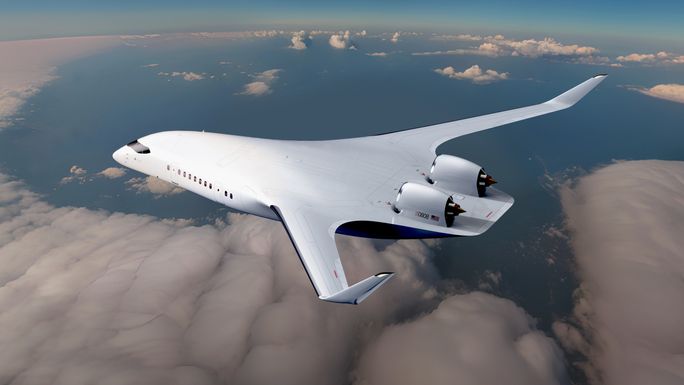
JetZero blended wing body aircraft rendering (Photo Credit: Courtesy JetZero)
ZeroAvia’s Hydrogen Electric Jets
Hydrogen-powered flight will soon be a reality, thanks to ZeroAvia’s innovative hydrogen-electric jet engines. The clean aviation company is developing engines that will be compatible with existing aircraft and emit zero emissions in-flight except for water vapor. Since 2023, the company has been using a prototype engine to power test flights aboard a small plane in the English countryside. The longest flight powered by the hydrogen-electric prototype reached 35 minutes in April 2024. ZeroAvia is also designing a larger version of the engine, which will power popular regional jets like the Bombardier CRJ700. This idea caught the attention of American Airlines, which agreed in the summer of 2024 to purchase 100 of the engines when they become operational.
Boom Supersonic Overture Jet
Boom’s mission to bring back commercial supersonic flight got a significant boost in June when President Trump signed an executive order to overturn the ban on supersonic flights over land. The practice was outlawed more than 50 years ago due to the loud sonic “boom” that erupts when an aircraft breaks the sound barrier.
Fortunately for those in the flight path below, Boom plans to operate so-called “boomless” flights in which there is no audible sonic boom that reaches the ground when the aircraft crosses Mach speeds. The company hit a huge milestone in January 2025 when it operated its first quiet supersonic flight with its XB-1 demonstrator aircraft. The test flight reached Mach 1.12 speed over the Mojave Desert. “Next, we are scaling up the technology on XB-1 for the Overture supersonic airliner,” Boom CEO Blake Scholl said at the time. “Our ultimate goal is to bring the benefits of supersonic flight to everyone.”
The Overture aircraft will travel at Mach 1.7 speeds and cut travel time in half. That means flying routes like Tokyo to Honolulu and New York to London in just under four hours. According to Boom, it will be possible to: “Leave New York in the morning. Prepare for meetings on the flight. Land in London in time for an early business dinner.”
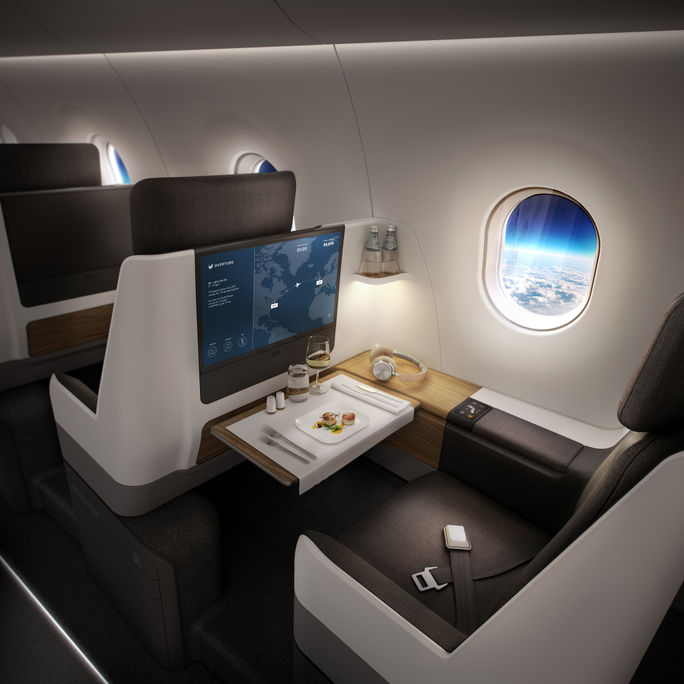
Boom Supersonic Overture cabin rendering (Photo Credit: Courtesy Boom Supersonic)
Inside the aircraft, Boom plans to design an all-premium cabin, featuring “ample room to relax or focus with large windows, premium materials, and next-gen in-flight connectivity.” It estimates that fares will be similar to current business class tickets. The jets can also run on up to 100% sustainable aviation fuel. Because the jets will fly at an altitude of 60,000 feet, passengers will be able to see the curvature of the Earth from their window.
Major airlines have plans to add Overture aircraft to their fleets, including two U.S. carriers. United Airlines has agreed to purchase 15 aircraft, with the option to buy 35 more, and American Airlines has a deposit for up to 20 aircraft, with an option for 40 more. Japan Airlines also has an option for 20 of the supersonic planes. The company is on track to get FAA certification for Overture by the end of the 2020s and aims to have the jets in commercial service shortly after.
Topics From This Article to Explore


