After the painful pandemic and the dizzying rush of revenge travel in 2023, this year has seen a return to normal patterns where travel advisors have to be proactive in seeking bookings, rather than seeing them line up at the (often virtual) door.
“It’s not like 2023,” said ACTA President Wendy Paradis, speaking to an engaged crowd of 500 travel advisors and 200 supplier representatives at the advocacy organization’s Eastern Canada Summit in Toronto.
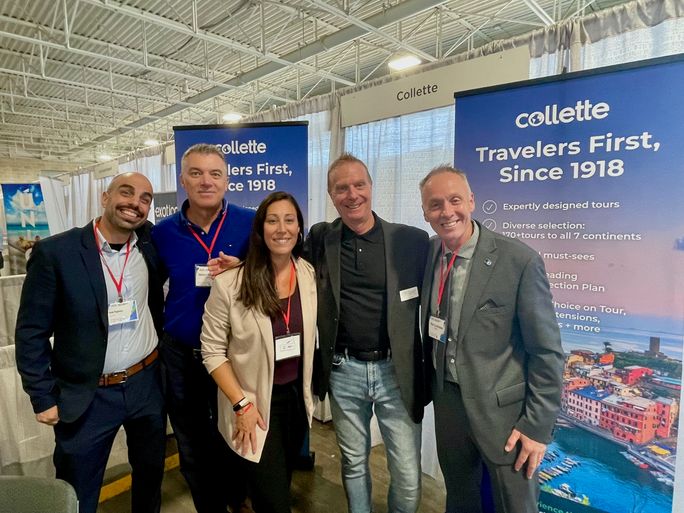
The Collette crew at the ACTA Eastern Canada Summit trade show. (Photo Credit: Bruce Parkinson)
“We need to hustle for business. We need to be smart, nimble and more proactive,” Paradis added.
The day was ably hosted by Ryan McElroy, CEO and co-founder of Travel Agency Tribes, a provider of B2B2C travel marketing technologies. Praising the pleasures of “an industry that will show you the world,” McElroy used his keynote speech to urge travel advisors to focus on the “core memories” that travel delivers.
“Stop marketing for bookings and start marketing for memories,” McElroy said.
Paradis said that while a return to normal patterns means advisors have to compete with more vigour, the future for the industry remains bright.
She cited robust demand and growth, the continued return of business travel and increased capacity plans over the next decade as positive markers. Potential obstacles are always there, Paradis said, ranging from geopolitical factors to the weakness of the Canadian dollar, fuel prices to labour disruptions.
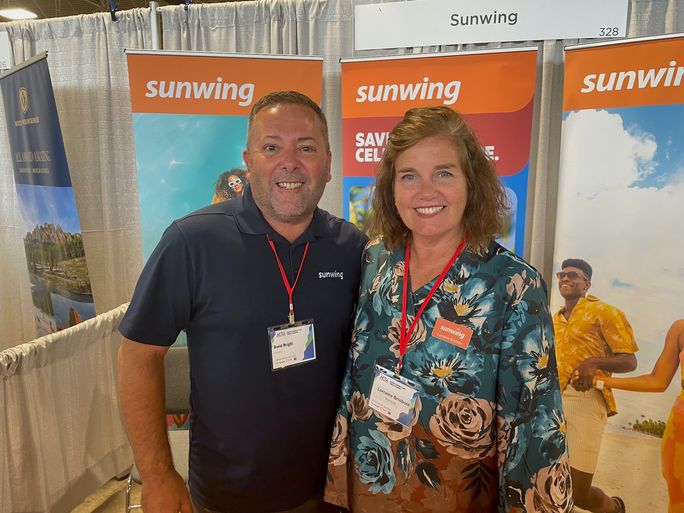
Sunwing veterans David Wright and Lorraine Brisbois welcomed advisors at the ACTA Eastern Canada Summit Trade Show. (Photo Credit: Bruce Parkinson)
On that topic, Paradis addressed the “elephant in the room,” – the potential of an Air Canada pilot strike as early as September 18 – which is already giving travel advisors major headaches as they work to protect their clients’ plans.
“We are urging Air Canada, the pilots union and the federal government to work really hard to find a solution ASAP,” Paradis said. “Everybody is really stressed about this and there is a tremendous among of rework going on.”
While recommending that advisors “plan for the worst,” Paradis also said she believes both sides in the labour dispute are “motivated towards a solution.”
During eight years at the helm of ACTA, Paradis, who began her career as a travel advisor, has reenergized the industry association, a fact made apparent by the size and enthusiasm of the ACTA Summit audience.
“The biggest change in ACTA philosophy is a louder, more cohesive voice on building a better travel industry. Advocacy is the number one reason for being with ACTA,” Paradis said. She says the organization has seen “incredible engagement” from (travel advisor) members and strong support from industry leaders including key suppliers and host agency executives.

Travel advisors Cathy MacKinnon and Sabrina Elliott at the ACTA Eastern Canada Summit. (Photo Credit: Bruce Parkinson)
“We have a much better and stronger ACTA and travel industry community in Canada,” Paradis said.
It’s also a much different industry, as the pandemic accelerated an industry trend toward independent, home-based travel advisors working with host agencies. In the bricks-and-mortar segment, mergers and acquisitions continue, as older agency owners retire from the business.
After years when many doubted the viability of planning and selling travel as a profession, the evolving industry is once again attracting new blood. About 20% of the advisors attending the ACTA Summit have been in the business for two years or less. ACTA has responded to the welcome influx by creating new tools and training resources for newcomers to the industry.
The travel market is changing too, Paradis said. For 2025, millennials – those born between 1981 and 1996 – will lead the way in travel spend, followed by Generation Z (born 1997-2012), Generation X (born 1965-1980) and Boomers (born 1946-1964).

Iorandus Travel Management Specialist Darlene Wipp with Brian Joseph, Hyatt Inclusive Collection, at the ACTA Eastern Canada Summit tradeshow. (Photo Credit: Bruce Parkinson)
Paradis says they are all important target markets and points out that Boomers still hold the bulk of wealth and will remain high-opportunity clients for years to come.
Luxury travel is a focus of many travel advisors these days, and a constant part of industry conversation. But how many people can actually afford to travel in pampered luxury? Paradis says it’s not so much the size of the market but the propensity to work with travel advisors that makes affluent travellers so attractive.

Visit Portugal Director Canada Inês Almeida Garrett spoke at the ACTA Summit. Portugal's Azores will host 150 ACTA member agents on an educational fam in November. (Photo Credit: Bruce Parkinson)
‘Eighty-five per cent of luxury travellers prefer to work with travel advisors,” Paradis said. “That’s why we hear so much about it. It’s a group with high expectations, but there’s a good return on effort when you focus on the right bucket.
Paradis’ success as ACTA leader can be partially attributed to her origins in the business, and her knowledge and understanding of the travel advisor role.
“In my heart I’m still a travel advisor. I decided at 16 that was what I wanted to be.”
Topics From This Article to Explore


