
by Debbie Olsen
Last updated: 10:20 AM ET, Wed March 11, 2026
Wouldn’t it be great to be able to predict the future? The travel industry is notoriously unpredictable because it is affected by so many external factors. Natural disasters, health crises, political instability and economic fluctuations create sudden shifts in consumer demand. While it’s nearly impossible to know for certain what the future holds, a deep dive into the present can provide a good indication of where the travel industry is headed, helping travel advisors and agencies plan ahead.
From November 4 to December 18, 2025, Travel Weekly and Phocuswright (sister brands of TravelPulse Canada), along with sponsors Ensemble, Princess Cruises and Globus, conducted an exclusive online survey of Canadian travel advisors and travel agency owners. Please also have a look at the insights in part one and part two.
The survey was fielded through Northstar Travel’s media database and several industry partners. To qualify, respondents had to work for or own a travel agency. The responses were collected and analyzed to provide a snapshot of the current travel agency landscape in Canada and identify trends shaping the industry. Here’s what travel advisors should know about current best practices and about planning ahead for 2027.
Booking Travel
How are Travel Advisors Booking Air for Their Clients?
There was a time when travel advisors manually checked schedules, called to verify seat availability, and issued physical, handwritten paper tickets. By the 1970s and 80s, systems like Sabre, Apollo, and Amadeus became standard, allowing agents to directly access inventory and fares through Global Distribution Systems (GDS). Today, travel advisors have many choices when it comes to booking airline tickets for clients and GDS is just one of them.
Now, the top method for booking air for clients was through a consolidator/wholesaler (22%). Using a GDS interface (18%) and booking via an airline’s agency portal (17%) were also listed as preferred ways to book air.
What’s the Most Popular Way to Book Hotels?
There are many different ways to book hotels for clients. The top agency hotel booking channels are via specialized websites/systems for travel agents (43%), through a consolidator or wholesaler (16%), direct through the hotel’s website (14%) and through an agency or consortium's proprietary website (12%).
New Technology Tools for Selling Travel
The travel industry is constantly evolving, so it’s no surprise that travel advisors as a general rule are quick to embrace new technology. The survey found that 80% of travel advisors feel cautiously optimistic or excited about adopting new tech tools.
What is IATA’s New Distribution Capacity and how do travel advisors feel about it?
IATA’s New Distribution Capability (NDC) is an XML-based data standard that allows airlines to distribute fares, rich content, and personalized ancillaries directly to travel agents, bypassing traditional, limited Global Distribution Systems (GDS). In 2025, a larger share of agencies was provided access, but nearly six in 10 advisors (58%) remain unfamiliar with NDC. Among advisors familiar with NDC, most have a positive or neutral attitude toward the technology.
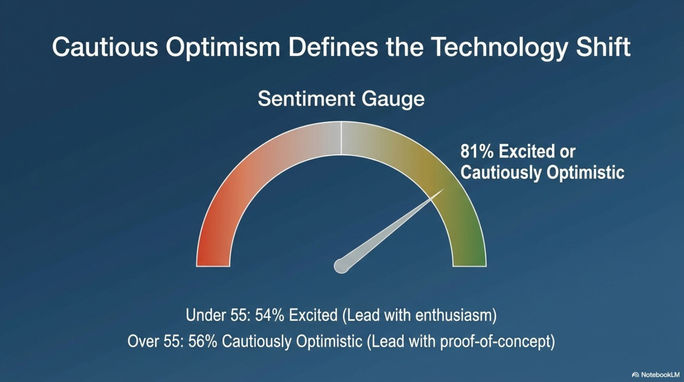
Gauging technology adoption attitudes (Photo Credit: Northstar Travel Media)
Is AI the Future?
Artificial Intelligence (AI) is not just the future; it is the present. Usage of AI platforms and tools surged among travel advisors in 2025. Nearly six in 10 advisors (59%) have used the technology.
How are Travel Advisors Using AI Tools?
Travel advisors are using AI to boost efficiency and increase personalization. They are most likely to be interested in using AI to create emails/marketing materials and generate custom itineraries. Nearly four in 10 agency owners/managers have used AI to create emails, marketing materials or website content. They have also used AI to generate itineraries (28%) and curate packages (25%), with more planning to do so in the coming year.
How NOT to use AI
Advisors are least likely to want to use an AI chatbot for customer support. When contacting airlines and other travel suppliers, advisors have experienced the frustration of working with a chatbot and want to provide a more personal means of support to their clients. This put the idea of using a chatbot for customer support dead last on the advisor survey. Barriers to using AI revolve around the degree of accuracy (64%) and lack of personal touch (64%).
Strategies for Growth and Client Retention
It takes less time, effort and money to retain an existing client than to attract a new one. Loyal customers spend more, have higher lifetime value, and boost profits. Almost four in 10 travel advisors (39%) ranked increasing repeat business from existing clients as their most important growth strategy over the next 12 months. Other significant growth strategies include strengthening online presence/digital marking (28%), developing group travel programs (23%) and training and skill development (23%).
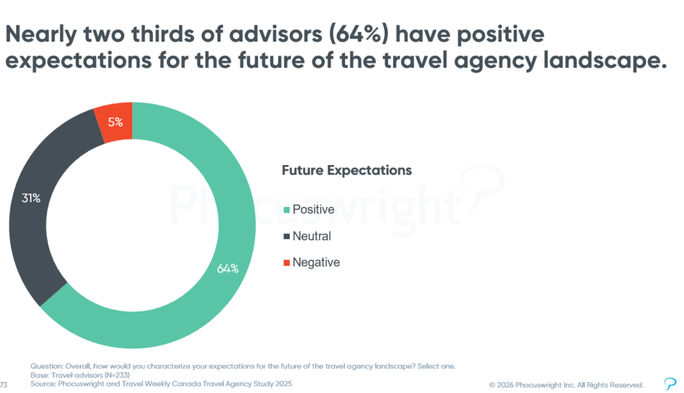
The outlook for 2026 is largely positive (Photo Credit: Northstar Travel Media)
Looking Back - What have been the biggest challenges in the past 12 months?
The increased cost of travel due to inflation was ranked as the number one challenge over the past year by 70 percent of travel advisors. The value of the Canadian dollar (53%), high airfares and fees (48%) and uncertainty due to changing government policies (40%) were other significant challenges.
Looking Ahead - What will be the biggest industry challenges in the next 12 months?
The advisors surveyed anticipate high costs and currency valuation to remain the most impactful challenges in the next 12 months.
The Future is Bright
Consumer demand for travel is at an all-time high and travellers are increasingly seeking, and paying for, the expertise of travel advisors to navigate complex logistics and reduce stress. Nearly two thirds of advisors (64%) have positive expectations for the future of the travel agency landscape.
Topics From This Article to Explore


