The Institute for Economics & Peace (IEP) has released its 2026 Global Peace Index (GPI), revealing the countries providing the most stability for travelers amid uncertain times.
The Global Peace Index measures peace, the absence of violence and the fear of violence on 23 indicators across three domains, including Ongoing Conflict, Safety & Security and Militarization. Therefore, the GPI is more of a high-level barometer of a country's overall stability.
IEP Founder and Executive Chairman Steve Killelea encourages travelers to "use the GPI to understand a country's overall stability, then pair it with official government travel advice and destination-specific research for the practical, on-the-ground questions."
"The two are complementary; the Index gives the strategic picture, the advisories give the tactical detail," he told TravelPulse.
Europe Continues to Set Standard for Stability and Security
Iceland's dominance at the top of the GPI continues this summer, ranking as the most peaceful country in the world for the 19th straight year in 2026.
The European island country benefits from having no standing military and extremely low crime. It claims the top spot by a significant margin with a score of 1.161.
"Its position rests on three things that move slowly and reinforce one another: an almost complete absence of militarization (its militarization domain score of 1.027 is among the lowest in the world, Iceland has no standing army), very low levels of ongoing conflict (1.101), and a strong safety and security environment (1.288), reflecting low violent crime and high trust in institutions," said Killelea.
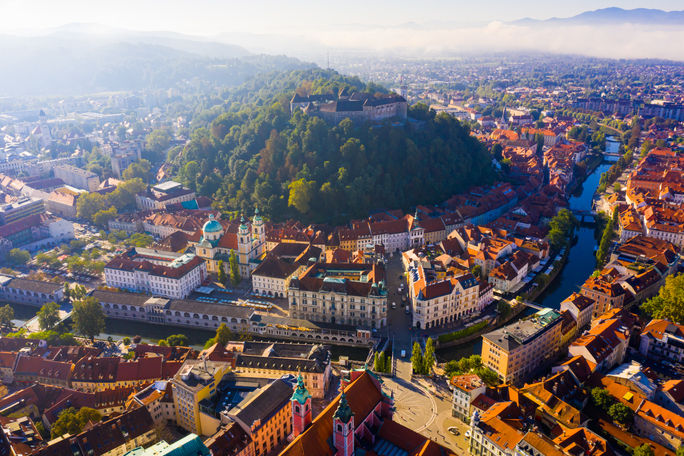
Sunny fall day in Ljubljana, Slovenia. (Photo Credit: JackF/Adobe)
Rounding out the top five most peaceful countries for 2026 are New Zealand, Switzerland, Slovenia and Ireland.
New Zealand climbed one spot from 2025 after recording the lowest ongoing conflict score of any country in the Asia-Pacific region, while Switzerland continues to be one of the most reliably stable and secure destinations on earth.
Meanwhile, experts consider Slovenia the most underrated country at the top of the GPI, with travelers perhaps far more familiar with neighboring Austria and Croatia.
World's Most Peaceful Countries for 2026
- Iceland
- New Zealand
- Switzerland
- Slovenia
- Ireland
- Austria
- Portugal
- Singapore
- Finland
- Japan
As for what these countries have in common, Killelea pinpoints "strong rule of law, well-functioning and accountable institutions, high social cohesion and trust, low corruption, and little or no involvement in external conflict."
"Geographically, the top tier is concentrated in Western and Central Europe, the most peaceful region in the world, alongside a handful of high-performing Asia-Pacific democracies," he adds.
Rising and Falling
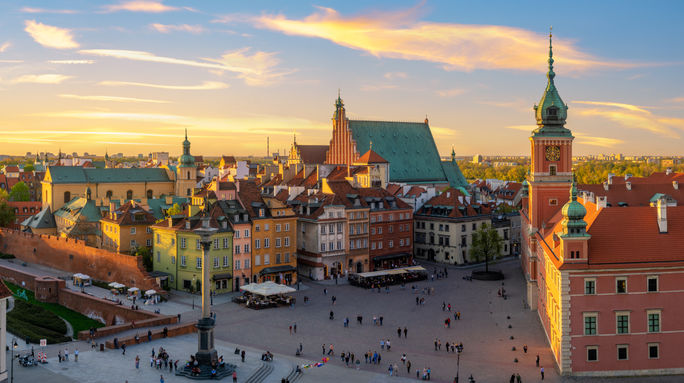
Old Town, Warsaw, Poland. (Photo Credit: Mike Mareen/Adobe)
An island country in the Indian Ocean off the east coast of Africa, Mauritius jumped 11 places to 18th in this year's GPI.
However, the biggest riser in 2026 was Poland, which climbed an impressive 23 places to 22nd overall.
"Countries that strengthen institutions and social cohesion tend to recover faster from shocks and to climb steadily rather than overnight," said Killelea.
Meanwhile, South Asia saw the largest regional deterioration in peacefulness, with Nepal falling 26 places, the most by any country this year.
Global Peace Hits Historic Low
The 20th iteration of the GPI also suggests significant work to be done, as peace has reached a historic low this summer.
The dismal mark is attributed to multiple factors, including a geopolitical shift stemming from the rising influence of middle powers and the waning strength of traditional European powers, known as the "Great Fragmentation," that's being compounded by rapid technological revolution in warfare.
Results show that a whopping 99 countries experienced a deterioration in peacefulness in the past year, which is the highest number since the index began. In fact, 119 countries (73 percent of the world) are now less peaceful than when the GPI was first published in 2007.
The GPI also shows that the number of countries engaged in external conflict has nearly doubled from 59 in 2008 to 103 in 2026.
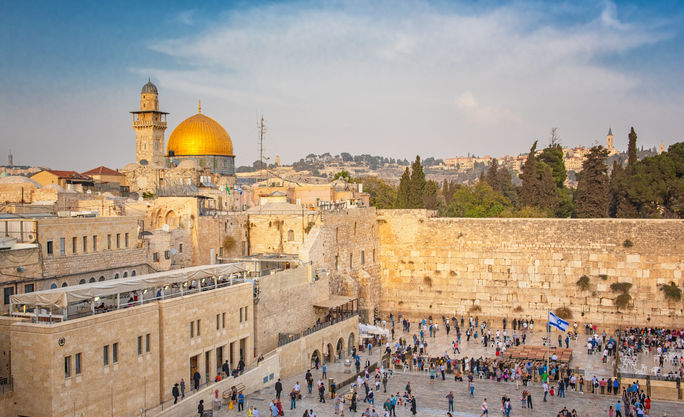
Old City of Jerusalem, Israel. (Photo Credit: Horváth Botond/Adobe)
Alarmingly, experts report that the global economic impact of violence increased by 3.2 percent to $21.81 trillion in 2025, equivalent to 10.5 percent of global GDP.
Drone attacks are also on the rise, jumping 11,500 percent between 2018 and 2025 as AI rapidly improves. As a result, deaths from global conflict remain at historic highs, with over 181,000 killed in 2025. That figure marks a disconcerting six-fold increase since 2008.
When it comes to the world's least safe destinations for 2026, the lowest-ranked countries are plagued by war, including Russia's war on Ukraine and Sudan's civil war turned severe humanitarian crisis.
World's Least Peaceful Countries
- Russia
- Sudan
- Democratic Republic of Congo
- Ukraine
- Israel
On a positive note, the GPI shows that successful diplomacy to prevent a restart of the Iran war would be worth approximately $2.2 trillion to the global economy.
"The single biggest lesson is that peace is built on strong institutions, not on geography or wealth alone," adds Killelea. "The countries at the top of the Index score highly on what we call Positive Peace: strong governance, low corruption, a sound business environment, the free flow of information, good relations with neighbors and high levels of social inclusion."
"These are structural attributes that a country can deliberately invest in, and they are what make the top tier durable even when the global environment deteriorates," he said.
Topics From This Article to Explore


