With more Canadians looking to vacation in Mexico instead of in the U.S., the time is ripe to suggest to clients some new, non-beach destinations. Inland colonial gems like Oaxaca de Juárez — typically referred to as Oaxaca City — capital of the southern state of the same name, Oaxaca (wah-HAH-kah) fits the bill perfectly.
The fifth largest state has eight regions with 16 Indigenous groups and languages (the Zapotecs and Mixtecs are the best known), making it the most ethnically diverse state.
At the Adventure Travel Network Mexico Conference (ATMEX), I discovered a well-developed tourism infrastructure, encountered lots of tourists (but not too many) and I felt safe, even at night. (According to Mexico’s Ministry of Tourism, Oaxaca is amongst the top four Mexican destinations for safety. In 2024, almost 54 percent of Oaxaca’s international tourists were single women.)
I toured the easily walkable five-square-kilometre city centre chockablock with Crayola-coloured buildings for three days (tell clients good walking shoes are essential) and participated in a four-day ATMEX FAM hosted by Chimalli Travel Group, a leading tour operator and full-service DMC.
The FAM, which included North American travel advisors, focused on the city and several sites and villages in the surrounding Central Valleys, each of which specializes in producing a craft, food or beverage product.
Why Go?
In one week we experienced many of the things Oaxaca City and region are renowned for: artisans and handicrafts, arts and culture, cuisine and mezcal, and archaeological sites. To give you a taste of what your clients can expect, here are some highlights.
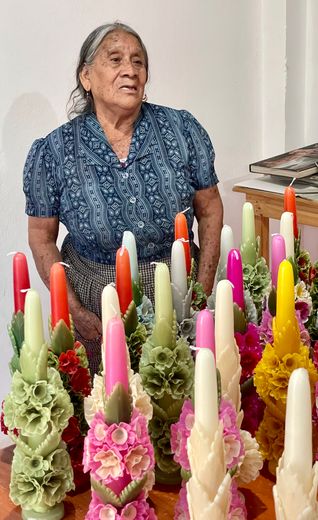 Master candlemaker Doña Viviana Alávez with her intricate floral candle creations, which are completely handmade. (Photo Credit: Theresa Storm)
Artisans and Handicrafts
While the Zapotec village of Teotitlán del Valle is famous for its handwoven wool rugs, lovingly made ceremonial beeswax candles are a lesser known speciality of the town. Candles symbolize light, guidance and hope.
Upon entering Casa Viviana, the tidy hacienda-style house of Doña Viviana Alávez, a light honey fragrance hung in the air. In her candle workshop, which occupies two rooms and a dirt-floored courtyard, we gathered around an ivory candle hanging from the ceiling almost reaching to the floor, its stem bedecked in elaborately-crafted 3-D ivory flowers. This candle and up to 20 more will soon grace a Catholic church wedding.
It began as beeswax sourced from Chiapas, the next state to the south, first poured into bowl-shaped sheets to bleach in the sun before being coloured with natural pigments. Then the artistry begins.
Alávez is famous for creating new designs, often adding details to the base candle like vivid multi-coloured regional flowers, each petal — like the entire candle — shaped by hand. A large candle can take three weeks and weigh up to 20 kilograms.
The 78-year-old master candlemaker began learning the centuries-old craft from her grandmother at the age of eight. She is the fourth generation to carry on the tradition, which she has passed on to her sons, daughter-in-laws and granddaughter to ensure its continuity.
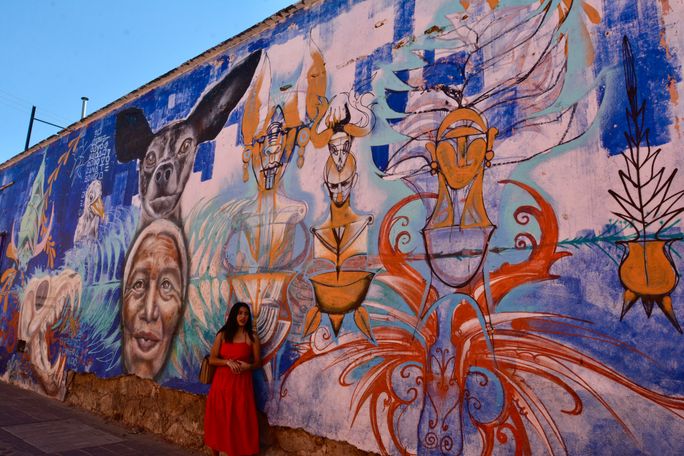
Guide Fer explains the meanings of the imagery in this stunning wall mural in the barrio (neighbourhood) of of Jalatlaco. Note the hairless Xoloitzcuintli dog, the guide to the underworld. (Photo Credit: Theresa Storm)
Arts and Culture
A free street art walking tour in the hip artsy neighbourhood of Jalatlaco with Oaxaca by locals (booked on freetour.com) was a highlight. Once on the wrong side of a now extinct river, in the late 19th century Jalatlaco was an undesirable leather tanning town, far from Centro.
For a couple of hours, we strolled cobbled streets past an array of jellybean-hued colonial buildings, protected by the city’s UNESCO status. Tour guide Fer explained there are two kinds of street art: acrylic murals and paste-ups, posters about issues that are only up for two to three weeks. If caught posting, the offenders can be jailed.
Several buildings sported elaborate beautiful murals, certainly painted by talented artists. Fer explained the meaning of each. For example, the Mexican hairless Xoloitzcuintli is the dog that guides one to the underworld.
Festivals
Oaxaca is renowned for its festivals, vibrant manifestations of Indigenous culture. Two that draw the most visitors are Dia de los Muertos (Day of the Dead) starting in late October. The most important days are Nov. 1 and 2.
Then, in late July, Guelaguetza, Oaxaca’s biggest fiesta, is a magnificent celebration of Indigenous cultures. Hundreds of the finest musicians and dancers from the state's eight regions perform in traditional costumes.
Book your clients far in advance.
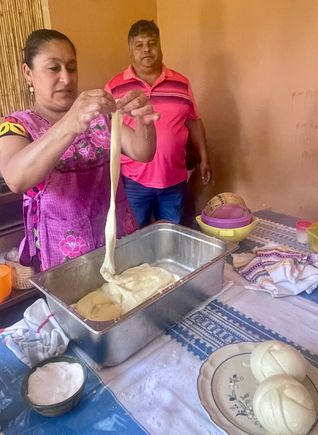 Patricia Narvaez shows us how to make quesillo cheese (also called queso Oaxaca) in her home kitchen in Reyes Etla, the birthplace of the Mexican staple food. (Photo Credit: Theresa Storm)
Oaxacan Cuisine
Oaxaca is Mexico’s culinary capital. Rooted in pre-Columbian flavours, basic ingredients are cocoa, corn and chili. Oaxaca is renowned for seven kinds of mole, a rich complex sauce sometimes made with chocolate; Oaxaca cheese; Oaxaca-style tamales wrapped in banana leaves; coffee; and artisanal chocolate and cocoa, often drunk hot with spices like cinnamon.
As the bustling markets can be overwhelming for newcomers, a tour is recommended.
We enjoyed a probaditas — a market tasting tour – with Chimalli guide Verónica Salgado Guzman to the Mercados Benito Juarez and the 20 de Noviembre next door.
A traditional gastronomic tour with Ethnofood to Central de Abastos, the locals’ market with very low prices, was the only way to tackle this sprawling mercado that covers the ground of six soccer stadiums.
On another day we joined Patricia Narvaez in the tidy outdoor kitchen of her home in the town of Reyes Etla, the birthplace of quesillo cheese (also called queso Oaxaca), a white, stringy, semi-hard and good melting cheese, to learn the art of making this regional — and Mexican — staple. She learned how from her husband’s family, who have been cheesemakers here for more than a century.
With 18 years experience making cheese twice daily, Narvaez makes the pasta filata technique look easy. With the help of her husband to drain the heavy tub of whey, she adds hot water and begins kneading the curds into a large mass that looks like rubbery dough. Next she stretches the curd into long ropes and cools them in water, before winding them into shiny balls. Fifteen minutes later, the final product is ready to sell.
By then we are hankering for hot-off-the-comal memelitas, thin fried masa cakes smeared with pork lard, beans, an optional fried egg and queso fresco, which Narvaez also makes. It is served with a smoky salsa and agua de Jamaica (hibiscus iced tea).
Mezcal in Oaxaca
Oaxaca is famous for mezcal, a smoky distilled natural spirit made from one of the state’s 30+ species of agave plant (called maguey in Mexico) and water. Palenques, traditional mezcal distilleries, line the highways in the Central Valleys, like wineries do in B.C. and Ontario.
Our group pays a private visit to Real Minero in Santa Catarina Minas, a mezcal town known for its unique technique of distilling mezcal in clay-pot stills rather than in copper alembics.
On tour, we learn about artisanal mezcal-making, here using grandma’s recipe, and the traditional distillation process. Later, in Real Minero’s cellar loaded with carboys of aging spirits, we tuck into delicious home-cooked chicken mole amarillo (yellow mole) and I discover two things: it’s my favourite mole and I like mezcal.
Back in the city, aficionados can visit Oaxaca’s abundant mezcalerias.
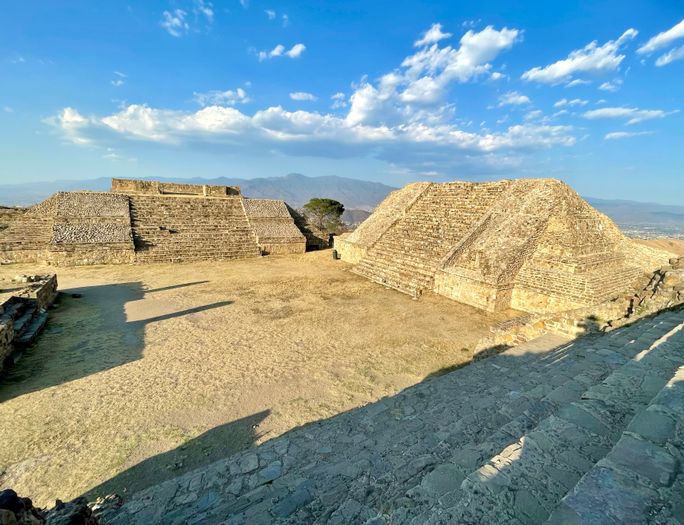
The UNESCO site of Monte Albán near sunset. (Photo Credit: Theresa Storm)
Monte Alban Archaeological Site
A sunset visit to Monte Alban after it closed to the public was most memorable for our FAM group.
Perched 400 metres above the valley floor with a commanding view of four valleys, Monte Alban is the most important archaeological site in the Oaxaca Valley. It was a pre-Columbian ceremonial centre for the Zapotecs that dates to 500 BC, making it one of the oldest Meso-American cities. For 1,500 years, it was inhabited by the Olmecs, Zapotecs and Mixtecs in succession, before being abandoned.
Inside the stone walled city, we admired the architectural remains of tombs, temples, an observatory and a ball court. “The terraces, dams, canals, pyramids and artificial mounds of Monte Albán were literally carved out of the mountain and are the symbols of a sacred topography,” UNESCO states.
Besides the historic ruins, panoramic views are another draw. To watch the sun sink into the hilly western horizon, we climbed steep steps to the top of a pyramid, where the mountain had been levelled to create a platform. It was a sunset all the more special because it was just for us in timeless Monte Albán.
All activities were organized and guided by Chimalli Travel Group, unless otherwise noted. To learn more about Chimalli Travel Group, see chimalli.travel. To learn more about ATMEX, see atmex.org.
Topics From This Article to Explore


