Air Canada landed in Israel for the first time in six months last week, returning only after performing what it describes as an extensive safety analysis, including consultations with government authorities, unions representing flight crews and security experts.
Just four days later, Saturday’s AC flight from Toronto to Tel Aviv was cancelled "in response to current developments in the region."
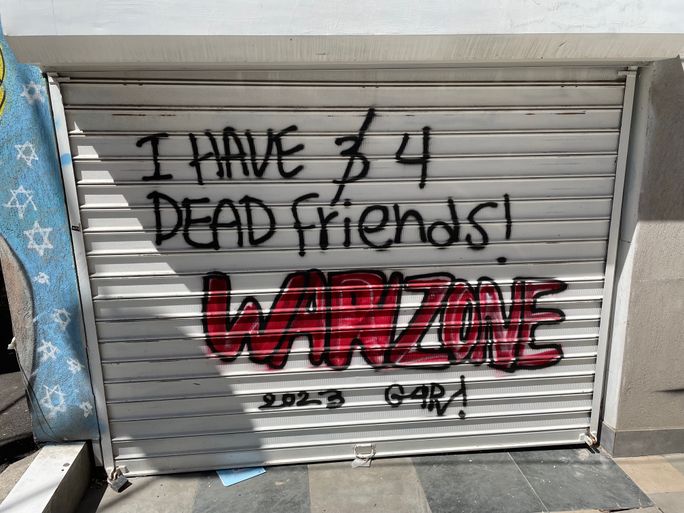
Tel Aviv's street art changes rapidly as Israel's situation evolves. (Photo Credit: Bruce Parkinson)
Those ‘developments’ took the form of a dramatic missile and drone attack by Iran, distinguished not by its minimal success – 99% of the more than 300 missiles and drones launched were intercepted -- but for the symbolism of directly targeting Israeli territory for the first time, after a decades-long shadow war between the Middle Eastern rivals.
The attack came as the promised response after Iran accused Israel of bombing its diplomatic complex in Syria in early April, killing senior Iranian military commanders.
Jordan was impacted by the Iranian missile barrage as well, shutting down commercial flights on Saturday night and intercepting Iranian drones that trespassed its airspace. As reported by TravelPulse Canada following a visit to Jordan in March, Jordan’s tourism has collapsed since the Hamas attack on Israel on October 7 and the ensuing war in Gaza.

During TravelPulse Canada's recent visit, life continued at nightclubs in Tel Aviv after six months of war. (Photo Credit: Bruce Parkinson)
In a statement, Air Canada says it will continue to monitor the situation in the region and adjust its 4X-weekly schedule Toronto to Tel Aviv accordingly. Weekly flights from Montreal to Tel Aviv are currently scheduled to resume in May.
TravelPulse Canada returned from a visit to Israel on April 8. In the days following, as tension rose and Iran signalled that an attack was imminent, Canada upgraded its travel advisories to Israel and the West Bank, instructing Canadians to avoid all travel to the region. Previously, the federal government had advised Canadians to "avoid non-essential travel" to Israel and certain areas of the West Bank.
"With a heightened risk of attacks on Israeli territory, the regional security situation remains highly volatile & could escalate without notice," Foreign Affairs Minister Melanie Joly said in a post Friday on X.
A number of international carriers, including United Airlines and Ryanair, recently announced the resumption of service to Israel, which has been largely devoid of tourists for six months. While it appears that Iran’s response to the bombing of its diplomatic compound in Syria is complete, Israel has vowed to reply to the attack on its territory, ensuring that travel uncertainty will continue for the foreseeable future.
Topics From This Article to Explore


