
by Natasha Lair
Last updated: 12:25 PM ET, Thu February 5, 2026
First Nations leaders are advising members to reconsider travel to the United States.
According to reporting by CBC, the advisories come amid growing unease over what Indigenous leaders describe as unpredictable enforcement practices and the conditions in which detainees may be held while their identity or status is being verified.
The Assembly of First Nations (AFN) issued a statement in January advising First Nations people crossing the Canada–U.S. border to proceed with caution.
“Recent reports indicate that some First Nations members are experiencing increased scrutiny by U.S. Immigration and Customs Enforcements (ICE),” AFN stated on social media.
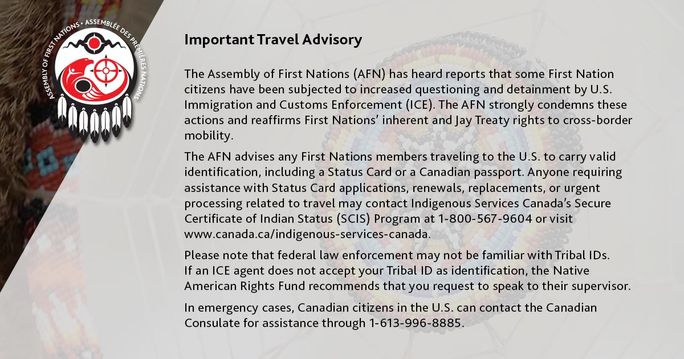
Assembly of First Nations travel advisory issued in January. (Photo Credit: AFN via Facebook)
The Okanagan Nation Alliance, the Upper Nicola Band and the Huu-ay-aht First Nations have since issued their own travel advisories.
In its advisory, the Okanagan Nation Alliance urged members to use “extreme caution” when travelling to the United States.
“We strongly condemn the violence of the US Administration, and its enforcement of immigration policies which are affecting our communities and relations throughout Turtle Island. The exercise of our inherent rights should not come at the expense of our safety and wellbeing. When the safety of Indigenous peoples is compromised, Indigenous sovereignty is compromised,” the advisory reads.
The Okanagan Nation Alliance represents the Syilx Okanagan Nation, which includes Okanagan Indian Band, Upper Nicola Band, Westbank First Nation, Penticton Indian Band, Osoyoos Indian Band and the Lower and Upper Similkameen Indian Bands, as well as the Colville Confederated Tribes in the United States on matters of shared concern.
First Nations people in the Okanagan and B.C. Interior had been planning to travel to Washington state to attend an Interior Salish conference.
The AFN said it “strongly condemns” actions that have led to First Nations citizens being “subjected to increased questioning and detainment by U.S. Immigration,” while reaffirming “First Nations inherent and Treaty rights to cross-border mobility.”
In Ontario, the Mississauga First Nation issued a travel advisory on January 19, followed by a similar warning on January 26 from the Aamjiwnaang First Nation.
As reported by National Indigenous Times, the advisories also underscore the historical context of cross-border mobility for Indigenous peoples, noting that communities have travelled freely across what is now the Canada–U.S. border since time immemorial.
“In 1794, the Jay Treaty was signed between the United States and Great Britain. This meant Indigenous People could pass freely across the border,” officials said.
Travellers are being urged to carry proper identification, including status cards and passports, when travelling to the United States.
Topics From This Article to Explore


