
by Natasha Lair
Last updated: 9:50 AM ET, Thu September 17, 2026
Confusion between two European border systems is growing as travellers navigate the rollout of the EU’s Entry/Exit System (EES) and prepare for the eventual introduction of the European Travel Information and Authorisation System (ETIAS).
New information shared by iVisa points to growing interest in ETIAS, with Google Trends data cited by the company showing worldwide searches for “apply for an etias visa online” increased 2,050% over the previous month as of Sept. 15. The catch: ETIAS is not yet operational and applications are not currently being accepted.
RELATED: Europe Indefinitely Delays Launch of ETIAS Travel Requirement
EES, meanwhile, is already operational.
The biometric border-management system was progressively introduced beginning Oct. 12, 2025 and became fully operational on April 10, 2026. It registers non-EU nationals travelling for short stays when they cross the external borders of 29 participating European countries.
Instead of relying on passport stamps, EES electronically records information including travellers' passport details and entry and exit dates, along with biometric data such as facial images and fingerprints where required.
RELATED: Europe Won't Suspend EES Despite Summer Travel Delays
There is no application or fee for EES. Registration takes place as part of the border-crossing process.
The rollout, however, has been accompanied by concerns over congestion and processing times at some European borders.
The EU's formal 150-day flexibility period expired Sept. 6, but nine countries — France, Belgium, the Netherlands, Germany, Greece, Malta, Portugal, Italy and Switzerland — have since reportedly been permitted to delay full implementation of EES while technical and operational issues are addressed.
ETIAS serves a different purpose.
Once introduced, ETIAS will be a pre-travel authorization for visa-exempt nationals travelling to 30 European countries, including Canadians. It is not a visa.
Travellers will apply online before departure, and the authorization will be electronically linked to their passport. According to official EU information, an ETIAS authorization will be valid for up to three years or until the associated passport expires, whichever comes first. It will allow eligible travellers to make multiple short-term visits, normally for up to 90 days in any 180-day period.
RELATED: Europe’s Tourism At-Risk Due to EES Delays, According to WTTC
The application fee will be €20, with exemptions from the fee for travellers under 18 and over 70.
ETIAS approval will not guarantee entry. Travellers will still be subject to border checks when they arrive.
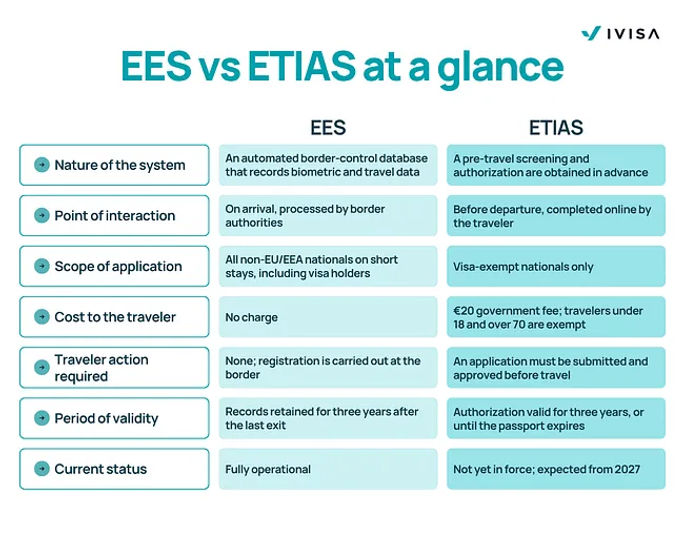
EES vs ETIAS (Photo Credit: iVisa)
Why The Two Systems Are Being Confused
Despite their similar names, EES and ETIAS operate at different stages of a trip.
EES is a border-control system that records a traveller's entry and exit. ETIAS will require eligible visa-exempt travellers to obtain authorization before departure.
RELATED: Europe Reportedly Delays ETIAS Rollout Until 2027
“The names are so similar that people assume they’re the same rule with two labels, and that’s where the trouble starts,” said iVisa’s Director for Customer Experience, Victor Gimenez.
“One is automatic, free and already active. The other is something you’ll need to sort out before you travel, and only if your nationality requires it. The mistake we expect to see is travelers turning up next year assuming ETIAS is handled at the airport the way EES is. It won’t be. Once ETIAS becomes mandatory, travelers who need one will need to have it sorted before departure.”
RELATED: Europe’s New Digital Border System Officially Launches: What Canadians Need to Know About EES
For Canadian travel advisors, the distinction is an important one to communicate to clients: EES is already part of the European border process, while ETIAS is a separate pre-departure requirement that has not yet launched.
The EU says no ETIAS applications are currently being collected and travellers should wait for an official launch announcement before applying.
Topics From This Article to Explore


