Transat made money in the fourth quarter of fiscal 2024, marking the first profitable quarter of a challenging year. Net income surged to $41.2 million in the three months ended October 31 versus $3.2 million in the same period a year earlier.
However, for the full fiscal year, adjusted earnings shrank by more than 25%, despite revenues increasing 8% to $3.05 billion. Net debt at the end of the quarter stood at more than $2 billion, up from $1.6 billion a year earlier.
“Clearly, we are not satisfied with these annual results,” said chief financial officer Jean-François Pruneau, in a conference call with financial analysts.
CEO Annick Guérard sees better days ahead, but her optimism is tempered by caution. On the positive side, she told financial analysts that demand remains strong among Canadian travellers, and that the company is “seeing early signs of a gradually improving competitive landscape,” -- demonstrated by better yields in Q4. She also noted that lower inflation and interest rates in Canada could give consumers confidence to spend on vacations.
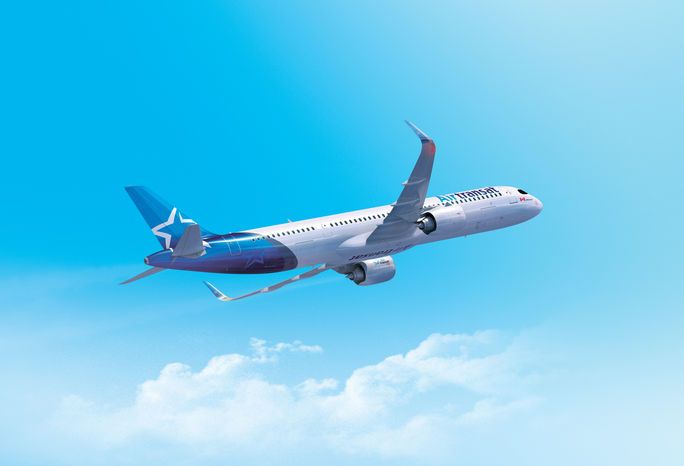
An Air Transat A321neoLR takes off. (Photo Credit: Transat)
“Consumers continue to have a strong appetite for travel, but as we have noted in previous quarters, they are looking for discounts before booking, such as those offered during Black Friday and Cyber Monday promotions. Revenues during this promotion increased by 9% compared to last year, highlighting the effectiveness of discount periods in driving bookings.”
Despite the strong demand, the Transat CEO stressed that “we remain in a context of high economic uncertainty which leads us to take a cautious approach to our predictions for next year.”
That uncertainty includes a Canadian dollar trading at its lowest level in years versus the U.S. greenback. And there’s certainly uncertainty around what will happen after January 20, when Donald Trump returns to the White House.
“The situation right now is not extremely stable in the economy. We don't know exactly what's going to happen with the -- when Trump is going to be in his position,” Guérard said. “But as we look at our data right now, load factors are up and RASM (revenue per available seat mile) are up as well. So, I think we're pretty much confident that that's going to be a better year than 2024.”
A primary focus for Transat in 2025 will be its “Elevation program,” described as “a comprehensive optimization plan designed to strengthen our operation and improve long-term performance.” The goal is to achieve an annual run rate improvement of $100 million in adjusted EBITDA by mid fiscal 2026. The company has achieved about $25 million of that goal to date.
“This is our primary focus and we are executing on it with full commitment and discipline. It is progressing as planned and it is on track to meet our targets. We have identified over 30 initiatives within the program that are being closely tracked and measured to ensure continuous value creation,” Guérard said.
The Transat leader identified three initiatives that she says have already started generating value for the organization.
· “First, the redesign of our structure, removing several management positions, ensuring a leaner or streamlined and agile organization.
· Second, the deployment of productivity tools in our call centre. By accelerating AI integration, we've enhanced efficiency, reducing average handle time and freed up 22% of agent capacity.
· Third, we are upgrading our distribution model by integrating new distribution capabilities (NDC), enabling direct connections with distribution partners. This is reducing distribution costs, increasing control over our offerings, and providing greater flexibility. It's important to emphasize that these three initiatives are simply illustrative example of the many actions already underway.”
Going forward, artificial intelligence will play a larger role in Transat’s systems and processes, identifying ways to save and seeking out customers willing to spend.
“We will also continue to overhaul our revenue management practices by introducing AI into our systems, leveraging willingness to pay, price elasticity and better customer segmentation.” Guérard said. “As we make steady progress, the efficiencies, focus and streamlined structure established will accelerate our strategic execution.”
Transat took delivery of seven aircraft in 2024, including four A321neoLRs and three A330s. But there are currently six grounded aircraft due to the Pratt & Whitney GTF engine issue, and with no new deliveries expected in 2025, capacity growth will be restricted.
In other 2024 positives, Transat execs noted a 7-percentage-points improvement in on-time performance in Q4 compared to the same time last year. They also noted that the company’s customer satisfaction score rose again in the fourth quarter.
Guérard called the launch of a joint venture with Porter “another key highlight” of the past year. “In fiscal 2024, we carried over 170,000 connecting passengers, marking a 175% increase compared to the previous year. Altogether, 4% of our passengers connected with Porter in fiscal '24, and we expect a significant increase in connectivity in 2025.

Transat CFO Jean-François Pruneau. (Photo Credit: Transat)
Capital structure -- the mix of debt and equity on a company's balance sheet – is a key issue for Transat going forward.
“At this stage, I think it's critical that we find the optimal capital structure,” said Pruneau. “It's not right as we speak. And we're looking at all the potential options that can be presented to us.”
With more than $800 million in federal government debt, Pruneau says negotiating “how we can amend and extend” that debt is a priority. But he acknowledged that other options could involve an external investor.
“ So, we need to think about all the options, and it's a question of fitting in everything to find the most effective and optimal way to build a capital structure that will be optimal for our stakeholders.
Topics From This Article to Explore


