
by Jen Mallia
Last updated: 12:10 PM ET, Thu June 19, 2025
In a newly released report from the Competition Bureau entitled “Cleared for take-off: Elevating airline competition,” the Canadian government set out the case for more competition in the domestic airline industry. The report concludes that opening the marketplace to more competition, including by looking to foreign airlines and foreign ownership, would drive prices down for consumers.
Competition Drives Airfare Down
The report points to research that indicates that when a new airline begins operating on a route, airfare falls nine percent along that route.
Research cited in the report shows that even with new and expanded airlines (think Flair and Porter), “the domestic market remains highly concentrated and competition from new sources remains fragile.” The report goes on to say that Air Canada and WestJet together account for roughly half to three-quarters (56% to 78%) of domestic traffic at Canada’s major airports. Market concentration has gone down by one tenth (10%) between 2019 and 2023.
Northern and Remote Communities
Another aspect of the report is dedicated to the unique challenges of operating in Canada’s North. Air passage is required for necessities such as work, healthcare, food, medicine and social connections. It is hampered by high operating costs attributed to:
- Small, widespread populations.
- The price of fuel, labour and housing.
- Poor runway conditions, outdated facilities, and unreliable systems to monitor weather.
Additionally, existing carriers control critical assets at the major northern airports, making it difficult for new entrants to the market.
Taxes and Fees
The high cost of flying in Canada is driven higher by surcharges and fees that the airlines don’t control. The report states, “These fees make up thirty cents of every dollar that passengers pay airlines (30%) for traditional full-service airlines. Those costs take up an even higher share of what passengers pay for flights on ultra-low-cost carriers (ULCCs).” It also notes that government subsidies or shifting the costs to all taxpayers rather than maintaining a user-pay system doesn’t make the costs go away.
Data and Pricing Transparency
The study also addressed making things easier for consumers to evaluate and compare, particularly regarding pricing and performance. Pointing to the U.S. and U.K., where performance metrics are more widely available, the study suggests that knowing an airlines’ record as far as timeliness and cancellations would affect consumer choices and drive airlines to do better. It also highlights the confusing way airfares are advertised, with the total cost (once “options” such as carry-on luggage or seat selection are calculated) not displayed until deep into the buying process.
Solution Suggestions
The report sets out recommendations to address the problems in the domestic airline industry. “With the right policy changes, governments can create the conditions for new airlines to grow and compete – and give Canadians access to more affordable, reliable options for flights,” says Matthew Boswell,
Commissioner of Competition. “With this report, we have identified concrete actions that governments can take to achieve these goals.”
The recommendations include:
- Prioritizing competition in Canada’s aviation policy, including in the review of airline mergers and collaborations.
- Leveraging international capital and experience to strengthen domestic competition, including reducing barriers to foreign ownership.
- Supporting northern and remote market access, including tailoring regulations to the northern context.
Airlines Weigh In
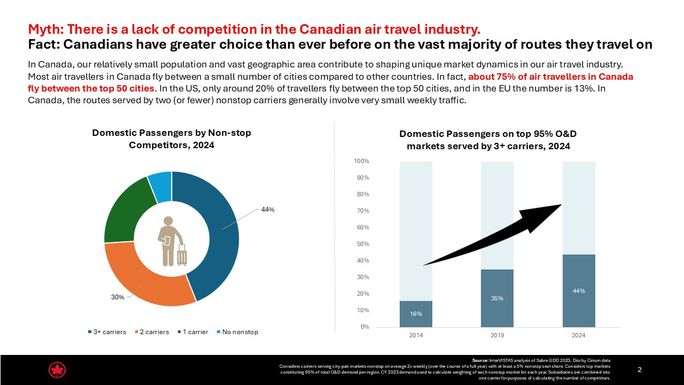
A slide from Air Canada's submission to the Competition Market Study (Photo Credit: Air Canada)
As may be expected, established airlines in Canada were eager to present information from their perspective, too.
Air Canada shared a slide deck outlining “Myths and Facts on the Canadian Domestic Competitive Landscape,” stating: “ As Canada’s flag carrier and the airline with the largest network and most services in Canada, we have a deep interest in a strong, competitive domestic market to best serve our customers.”
The presentation addresses misconceptions about domestic air travel, such as a perceived lack of competition in the Canadian marketplace, and refutes the idea that the barriers to entry for new carriers are too steep.
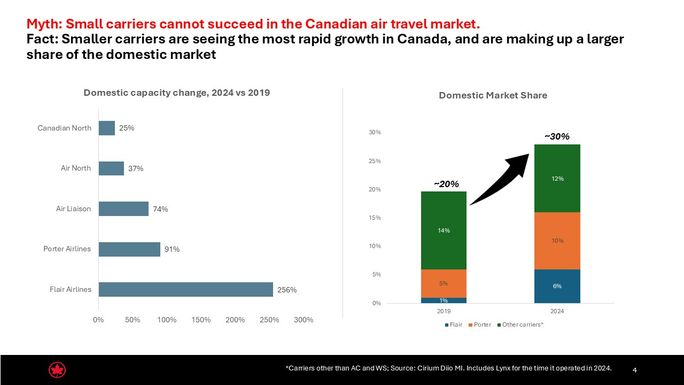
A slide from Air Canada's submission to the Competition Market Study
Topics From This Article to Explore


